Here is a brief overview of some of the tools and methods I used for creating the board and for the ongoing development.
Month: February 2026
Warning: Undefined variable $link in /home/yyzkevin/public_html/wp-content/themes/analog/inc/template-functions.php on line 143
About Month: February 2026
February 2026 Update 3
In the case of ISA-card projects, you can mostly assume you will be in a x86 PC and therefor trust that the user can run your configuration utility whether it is a standalone program or an option rom.
For PCMCIA however, the host machine could be many different architectures and an even wider range of operating systems. I previously demonstrated the onboard web-server that can be used, however not all platforms will support this and not everyone is even interested in networking.
A few things you may find yourself needing to change:
- Wi-Fi Settings
- Bluetooth Pairing (Gamepads and Mice)
- Card Mode (Network Adapter, SRAM, Etc)
- Audio DSP Parameters
These are the current methods for managing the card, all at varying stages:
- Webpage via Emulated NE2000
- AT commands via emulated COM/Serial Port
- MS-DOS utility
- External USB CDC Emulated Modem (And Web Browser)
- External USB Emulated Storage
- Config File
The above video shows off the concept of managing it via AT commands which is even more universal than NE2000.
February 2026 Update 2
Small follow-up to the previous update. I’ve now also finished the Bluetooth mouse support. This would also work with a USB mouse, in either case they are presented to the host as a serial mouse attached to a COM port so support should be universal.
February 2026 Update 1
Bluetooth Gamepads / Joysticks
I had planned this for a while and have finally got to it. It is working quite well. A2DP Bluetooth audio for wireless headphones also works but I will provide an update on that later. USB wired gamepads are still supported also (Thank PicoGUS!).
Wireless / Formfactor
A flush antenna worked technically but created even bigger compliance complications, so the plan now is to use the pre-certified Raspberry Pi RM2 radio module instead.
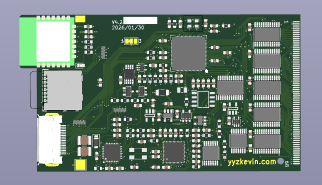
Initially I was not using the Raspberry Pi RM2 module as it did not exist when I started this project, and once it was announced I found the width was not compatible. Since then I switched to the HRS I/O connector which is narrow and saved space, and I have switched from a “Push-Push” to “Push-Pull” SDCard socket to also save some width, allowing the RM2 module to JUST fit. Downside is we are back to having a 5.2mm (just under 1/4″) PCB trace antenna sticking out, but the plus side we will have even better wireless reception.
I am waiting on PCB’s and I should have prototype to confirm no unexpected issue within the next week. It uses the exact same CYW43439 radio so not expecting problems.
Compliance / Certifications
I have a booking with the laboratory to do a day of pre-compliance testing for FCC Part 15 and related, as well as further testing/review on exposure limits and additional SAR tests to be in compliance as a portable device.
Some people ask me why I am so worried about compliance testing, and there are two sides to it.
No question this is an extremely low volume product/project, and although I did mention this is intended for development purposes, standing on that argument for an exemption is not very strong at best.
More importantly, unlike a lot of hobby projects where it is a card stuck in an old computer you turn on in your basement, this is a PCMCIA card that will be in laptops/pda’s etc and many of them will find themselves in public locations where it is more important they do not cause any interference or exceed any RF exposure limits.
Current Timeline / Plan
I have already purchase all of the components required that are in short supply and/or discontinued, so the risk of any delay due to supply chain is very low.
The boards I will receive next week (February 9th) should be very close to the final design. I have all the parts needed to build the prototypes and provided there are no issues I will be sending them out to various people for testing/review.
I expect some minor changes (mechanical,compliance), and plan to make a small batch of cards integrating those changes at the end of the month once the PCB factories come back from Holiday and get through their backlogs. If there are no issues with end-users on those cards I will gear up make the large batch of remaining cards.